In recent years, the medical community has witnessed what many are calling a “Psychedelic Renaissance.” Once relegated to the fringes of counterculture and strictly prohibited by global governments, substances like psilocybin and MDMA are now receiving FDA “Breakthrough Therapy” status. This designation is reserved for drugs that demonstrate substantial improvement over existing therapies for serious conditions. As we navigate a global mental health crisis, understanding what is psychedelics—and more importantly, how they function—has become a priority for researchers, clinicians, and the general public alike.
The shift in perception is rooted in data. Studies from institutions like Johns Hopkins and Imperial College London suggest that these compounds may offer relief where traditional SSRIs and talk therapy fail. But what are psychedelicsexactly? Beyond the vibrant visuals and altered states of consciousness, they represent a class of substances that “manifest the mind,” allowing users to access deeply buried emotions and cognitive patterns. In the United States, while most remain federally illegal under Schedule I, the landscape is shifting rapidly with statewide decriminalization and expanded clinical trials, making a clear psychedelics definition more relevant than ever.
This comprehensive guide explores the multifaceted world of these substances. We will delve into the history of psychedelics, analyze how do psychedelics work within the human brain, and examine the evidence-based benefits of psychedelics. By providing a neutral, expert-driven overview, we aim to clarify the role these compounds may play in the future of psychiatry and personal wellness.
When asking what are psychedelics, we must look at both the linguistics and the pharmacology. The term “psychedelic” was coined in 1956 by psychiatrist Humphry Osmond, derived from the Greek words psyche (mind) and deloun (to manifest). Therefore, a psychedelics definition essentially describes a substance that makes the hidden aspects of the mind visible.
Pharmacologically, the answer to what is psychedelics focuses on their interaction with the serotonin system. “Classic” psychedelics primarily act as agonists at the serotonin 2A (5-HT2A) receptor. This group includes:
Psilocybin: The active compound in “magic mushrooms”.
LSD: Lysergic acid diethylamide, a potent synthetic compound.
DMT: N,N-Dimethyltryptamine, found in Ayahuasca and produced endogenously in some mammals.
Mescaline: Found in cacti like Peyote and San Pedro.
Beyond the classics, there are “atypical” or “dissociative” psychedelics. Ketamine, for instance, acts on NMDA receptors but is frequently grouped into the psychedelic category because of its ability to induce non-ordinary states of consciousness and its efficacy in treating treatment-resistant depression. MDMA (3,4-Methylenedioxymethamphetamine), often called an empathogen or entactogen, is also a key player in the current clinical landscape, though it works primarily by flooding the brain with serotonin, dopamine, and norepinephrine.
In the legal context of the United States, what are psychedelics is defined by the Controlled Substances Act of 1970. Most are currently listed as Schedule I, meaning they are deemed to have “no currently accepted medical use and a high potential for abuse”. However, this legal definition is increasingly at odds with scientific reality. With Oregon and Colorado leading the way in regulated adult use and “Right to Try” laws expanding, the legal psychedelics definition is in a state of flux.
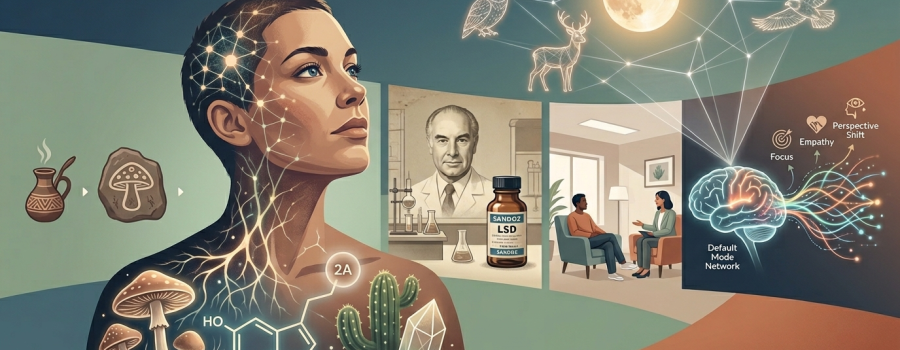
The history of psychedelics is as old as humanity itself. Indigenous cultures across the globe have utilized these substances for millennia in spiritual, medicinal, and communal rituals. In Central and South America, the use of Psilocybe mushrooms and Ayahuasca—a DMT-containing brew—dates back thousands of years, as evidenced by “mushroom stone” carvings and archaeological residues. In North America, the Native American Church has long used Peyote as a sacred sacrament. These ancient practices viewed the psychedelic experience not as a “drug trip,” but as a profound communion with the divine and the natural world.
The modern history of psychedelics began in a laboratory. In 1938, Swiss chemist Albert Hofmann synthesized LSD-25 while researching ergot derivatives for Sandoz Pharmaceuticals. It wasn’t until 1943 that he accidentally ingested the substance, discovering its powerful psychological effects. Throughout the 1950s and early 60s, LSD and psilocybin were seen as miracle drugs in psychiatry. Over 1,000 peer-reviewed papers were published, exploring their use in treating alcoholism, anxiety, and end-of-life distress. Luminaries like Cary Grant and Bill Wilson (co-founder of AA) famously praised their benefits.
However, the 1960s counterculture movement brought these substances into the public eye in a way that alarmed the establishment. Figures like Timothy Leary urged the youth to “Turn on, tune in, drop out,” leading to widespread recreational use and a subsequent political backlash. By 1970, President Richard Nixon signed the Controlled Substances Act, effectively ending legitimate research and beginning a decades-long “Dark Age” of prohibition. The history of psychedelics became one of underground use and clandestine chemistry.
The “Renaissance” we see today began in the late 1990s and early 2000s. Researchers like Dr. Rick Strassman (DMT) and teams at Johns Hopkins University (Psilocybin) began navigating the regulatory hurdles to resume human trials. Their success paved the way for the current era, where major cities like Denver, Oakland, and Seattle have decriminalized natural psychedelics, and multi-billion dollar biotech companies are racing to bring psychedelic-assisted therapy to the mainstream market.
While many people group all “hallucinogens” together, the scientific community recognizes several distinct types of psychedelics based on how they interact with the brain and their chemical origins. Understanding these categories is essential for anyone looking into therapeutic use or harm reduction.
Most discussions surrounding the types of psychedelics begin with tryptamines. These are structurally similar to the neurotransmitter serotonin.
Psilocybin: Found in over 200 species of mushrooms, this is currently the most studied compound for depression.
DMT (N,N-Dimethyltryptamine): Often called the “Spirit Molecule,” it produces short, intense experiences and is the active ingredient in Ayahuasca.
5-MeO-DMT: Derived from the Bufo alvarius toad or synthesized, known for producing profound “ego death”.
This category includes both naturally occurring and synthetic compounds that often have a more “stimulating” effect compared to tryptamines.
Mescaline: The primary alkaloid in Peyote and San Pedro cacti, used for millennia in indigenous traditions.
2C-B: A synthetic phenethylamine created by Alexander Shulgin, known for its mix of visual and empathogenic effects.
LSD (Lysergic acid diethylamide) is the most famous member of this group. These are complex molecules derived from ergot alkaloids found in fungi. They are unique among the types of psychedelics because they are active at extremely low doses (measured in micrograms) and have a long duration of action, often lasting 8–12 hours.
Some substances are grouped under the psychedelic umbrella because of their “mind-manifesting” qualities, even if they work through different biological pathways.
Dissociatives: Ketamine is the primary example here. It works on NMDA receptors to create a sense of detachment from the body and environment.
Empathogens (Entactogens): MDMA is technically a substituted amphetamine. It increases feelings of social connection and safety, making it a powerful tool for PTSD therapy.
To understand how do psychedelics work, we must look at the brain’s neurobiology. The primary site of action for classic psychedelics is the 5-HT2A receptor, located predominantly in the prefrontal cortex—the area responsible for complex cognitive behavior, personality expression, and decision-making. When a molecule like psilocybin binds to these receptors, it triggers a cascade of signaling that alters how different regions of the brain communicate.
One of the most significant breakthroughs in understanding how do psychedelics work involves the Default Mode Network (DMN). The DMN is a group of interacting brain regions that is active when we are not focused on the outside world—it is associated with self-reflection, rumination, and the “ego”. In many mental health disorders, such as depression and anxiety, the DMN is overactive or “rigid,” trapping the individual in negative thought loops. Psychedelics temporarily disintegrate the DMN. As the “ego” goes offline, brain regions that don’t typically talk to each other begin to form new connections.
The formula for this connectivity can be visualized as an increase in global brain entropy. In a state of ΔS>0 (increased entropy), the brain becomes more fluid. Functional MRI (fMRI) scans of participants under the influence of LSD show a dramatic increase in cross-talk between the visual cortex and other regions, which explains why users “see” music or experience synesthesia. This period of high connectivity is followed by a window of “neuroplasticity”—the brain’s ability to reorganize itself by forming new neural connections. This is why a single psychedelic session can lead to long-term changes in personality and behavior; it literally “re-wires” the brain’s pathways.
When people ask what do psychedelics do, they are often looking for the tangible outcomes of the experience. The benefits of psychedelics are primarily observed in the context of “Psychedelic-Assisted Therapy” (PAT). This isn’t just taking a pill; it involves a controlled environment, professional “sitters” or therapists, and a focus on “set and setting”.
Treatment-Resistant Depression: Psilocybin has shown efficacy in reducing depressive symptoms for months after just one or two doses.
PTSD Resolution: MDMA-assisted therapy has reached Phase 3 clinical trials, showing that a majority of participants no longer meet PTSD criteria after treatment.
Addiction Recovery: Studies on Ibogaine and Psilocybin suggest they can significantly reduce cravings for nicotine, alcohol, and opioids by disrupting the neurological habit loop.
End-of-Life Anxiety: For patients with terminal diagnoses, psychedelics can alleviate the paralyzing fear of death, fostering a sense of peace and acceptance.
Increased Openness: Users often report a long-term increase in the personality trait of “openness,” leading to more creativity and aesthetic appreciation.
However, it is vital to acknowledge the risks. While physically non-toxic and non-addictive, psychedelics can cause “bad trips”—periods of intense fear, paranoia, or confusion. In rare cases, individuals may experience Hallucinogen Persisting Perception Disorder (HPPD) or trigger latent psychosis in those with a family history of schizophrenia. This is why screening and professional guidance are critical components of the therapeutic model.
| Substance | Primary Source | Duration | Key Effects |
|---|---|---|---|
| Psilocybin | Fungi (Mushrooms) | 4-6 Hours |
Introspection, visual distortion, emotional breakthrough |
| LSD | Synthetic (Ergot) | 8-12 Hours |
Heightened patterns, analytical thought, ego dissolution |
| DMT | Botanical (Bark/Leaves) | 15-30 Minutes |
Short but intense “breakthrough” experiences |
| MDMA | Synthetic | 3-5 Hours |
Empathy, emotional safety, decreased fear |
| Ketamine | Synthetic | 1-2 Hours |
Dissociation, rapid antidepressant effects |
The current landscape in the USA is a “patchwork” of legality. While the federal government still classifies these substances as Schedule I, the history of psychedelics is entering its most legislative-active chapter. Ketamine clinics are now legal and operating in almost every major city, providing off-label treatment for depression. Oregon has launched the first state-licensed psilocybin service centers, where adults can undergo a supervised session without a medical prescription. Colorado followed suit, passing Proposition 122 to allow for “Natural Medicine” healing centers.
Safety in this modern era relies on the concepts of “Dosage” and “Integration”. Microdosing—taking a sub-perceptual amount of a substance—has become popular for productivity and mood, though clinical evidence is still catching up to anecdotal reports. Integration is the process of working with a therapist or coach after the experience to translate the “insights” of the trip into everyday life changes. Without integration, the benefits of psychedelics can often fade as the brain returns to its old DMN patterns.
For those interested in exploring these options, it is recommended to visit sites like MAPS.org or check for active clinical trials on the NIH website. Always review your local privacy policy and state laws before engaging with these substances.
In summary, what is psychedelics? They are more than just “hallucinogens”. They are powerful neurobiological tools that, when used correctly, can unlock the mind’s inherent ability to heal. From the ancient history of psychedelics to the cutting-edge brain scans explaining how do psychedelics work, we are seeing a shift from stigma to science. While we must remain cautious of the risks, the potential benefits of psychedelics for mental health are too significant to ignore.
As we continue to redefine the psychedelics definition in the 21st century, staying informed is the best way to ensure safety and efficacy. We invite you to subscribe to our newsletter for the latest updates on legal trials, scientific breakthroughs, and integration guides. Explore our site to learn more about the future of botanical and synthetic wellness.
Dedicated to the ethical distribution and scientific understanding of botanical compounds. We bridge the gap between ancient tradition and modern wellness through transparency and rigorous third-party testing.
Proudly serving a global community with carbon-neutral, discreet shipping from our primary distribution hubs.
© 2023 Legal Psychedelics Trip. All rights reserved.